A Beginner's Guide to Reading Poetry Aloud
There is a moment, just before a poem begins at an open mic, when the room decides whether to listen. It has little to do with talent, and even less to do with how well you know the poem. It is about whether the person at the microphone sounds like they know why they are standing there. Reading aloud is a craft in its own right, and like most crafts it is made of small, learnable pieces: where you breathe, how fast you move, which words you lean on, and how you hold the attention of the people in front of you.
Start with the breath, not the voice
Nerves show up in the breath before they show up anywhere else. Speakers run out of air halfway through a line, then rush the next one to catch up, and the poem starts to sound like an apology.
Begin by reading the poem silently and marking where you will breathe. Not after every line — that turns a poem into a list. Let punctuation and sense give you permission. Where a line is too long for one comfortable breath, choose a spot mid-line that does the least damage to the meaning, and mark it.
Then stand up. Shoulders down, weight even, one hand free of the page. Breathe from the belly rather than the throat, and take one full breath before your first word. Speak on the exhale and let the air do the work. If you run short, do not gasp; simply pause. An audience reads a pause as meaning. They read a gasp as panic.
Pace is a decision, not a mood
Most beginners read too quickly, especially in the first thirty seconds. Speed feels safe because it gets you to the end sooner, but listeners need room to catch up with images and ideas.
A useful test: read the poem aloud at roughly the speed you would use telling a story to someone sitting across a table from you. That is almost always slower than you think.
Some places to slow down:
- The final line of each stanza.
- Any phrase you want the audience to carry home with them.
- The moment just after the poem turns — the shift in tone, argument or scene.
Some places where you can move: lists, stretches of dialogue, and passages where the poem is gathering momentum rather than resting. Silence is a tool, too. A two-second pause after a line that lands feels enormous to you and perfectly ordinary to the room.
Emphasis gives the poem its shape
Emphasis is not volume. It is weight. You are choosing which words carry the meaning and letting the others go lighter, the way a sentence naturally stresses its important parts in conversation.
Take a line like The kettle clicks off and the kitchen goes quiet. Read flat, it is a piece of information. Now decide that the movement lives in clicks and quiet. Stress those two and the line becomes a small event. Too many stresses and the whole poem flattens into a drone.
Watch for two habits in particular: stressing every word equally, and lifting your pitch at the end of every line. That second one turns statements into questions and makes a confident poem sound unsure of itself.
Let the line breaks work
A poem has two rhythms running at once: the rhythm of the sentence and the rhythm of the line. Where a line ends in the middle of a sentence, use a small hold or lift rather than a full stop. A good way to hear the difference is to read the poem aloud once as prose, ignoring the line breaks, so you can hear where the sentences actually end. Then go back and let the lines interrupt them.
Make every word audible
Clarity beats volume every time. Consonants carry across a room; vowels carry feeling. Finish your word endings — say and, not an', unless you are doing it deliberately — and open your mouth enough for the vowels to travel.
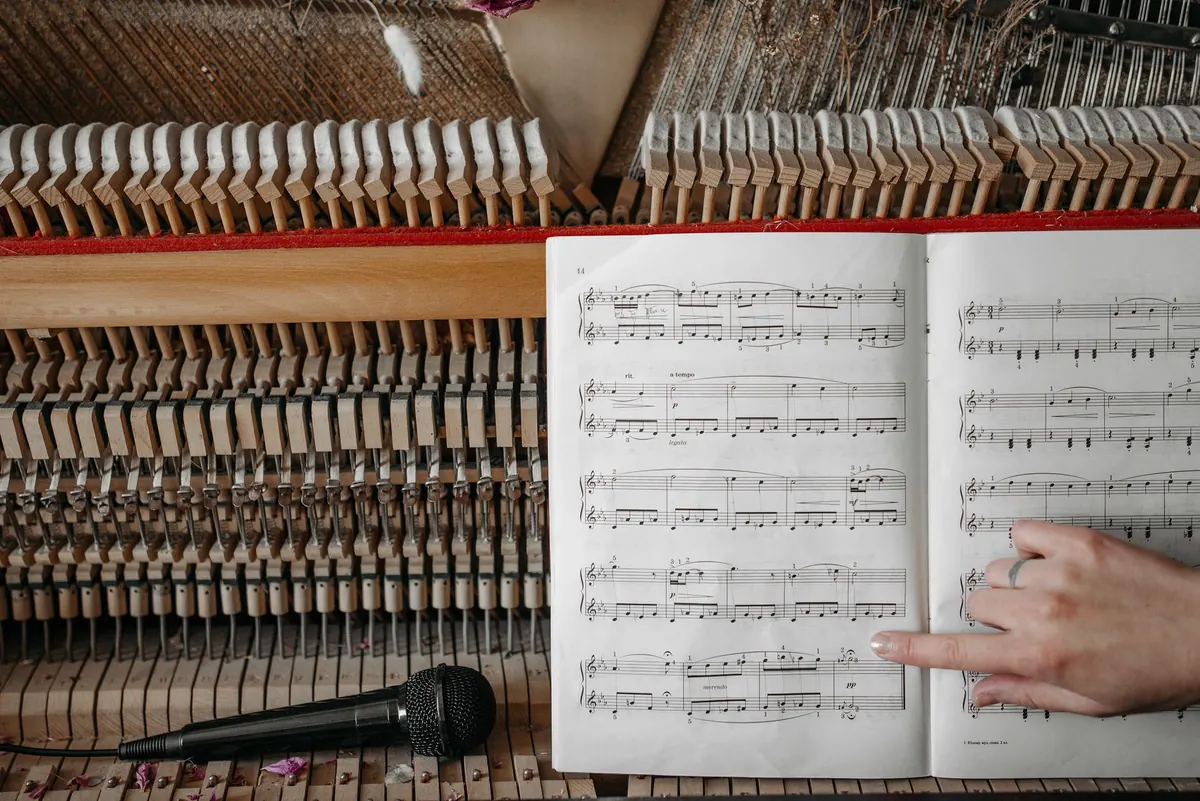
If you are working with a microphone, stand about a handspan away and test it with a simple "hello". Do not tap it. Hold your page to the side of your face rather than in front of it, and keep the paper still; rustling travels further than you would expect.
Record yourself once on a phone and listen back. Not to judge the poem, just to hear two things: whether you are rushing, and whether the ends of words are disappearing. Most people find one specific, fixable habit.
Connect with the room
Look up. That sounds obvious, but a page is a comfortable place to hide, and an audience can tell when they are being read at rather than spoken to. You do not need to memorise the whole poem. Learn it well enough that you can lift your eyes at the end of each stanza, and divide the room into three zones — left, centre, right — and move your gaze slowly between them.
Resist the urge to explain the poem before you read it. Give the title, and at most one line of context if it genuinely helps. Anything longer tells the audience what to think before they have heard a word.
If you stumble, pause, breathe, and pick the line back up. Nobody in the room is keeping score, and a calm recovery reads as composure rather than error.
A practice routine that works
- Read the poem silently twice: once for sense, once to mark breath points.
- Annotate your script. One slash for a breath, two for a longer pause, a line under the words you want to land.
- Read it aloud standing up, start to finish, at performance pace, without stopping to fix anything. Note where you fumble.
- Record one take and listen to it once, checking pace and clarity only.
- Rehearse the first three lines and the last two until they are automatic. Beginnings and endings carry most of the nerves.
- Read it to one person if you can. Not necessarily for feedback — just to feel how the words behave when somebody is listening.
On the night itself
Arrive early enough to hear a couple of other readers. It settles the nerves and tells you something about the room's acoustics, which will shape how loudly and how slowly you need to read.
Keep your script simple: large type, one poem per page, loose pages rather than a flapping notebook. Have some water within reach. Before you begin, plant your feet, take one breath, look up, and start.
You will probably read faster than you rehearsed, so aim to start at about nine-tenths of what feels natural. If your hands shake, that is adrenaline, and it usually fades after the first stanza. Afterwards, avoid pulling the whole reading apart. Choose one thing to work on next time and leave the rest alone.
The goal is not a flawless performance. It is being heard — line by line, by the people sitting in front of you.
Photo: MyriChagnon / Pixabay

You Might Also Like
From parish records and village memory to tense, place-aware storytelling: a practical guide to researching a British local legend and turning it into a short story.
A practical beginner's guide to haiku, explaining structure and seasonal words, with observation exercises, example rewrites and a month-by-month calendar of British weather and wildlife to write from.